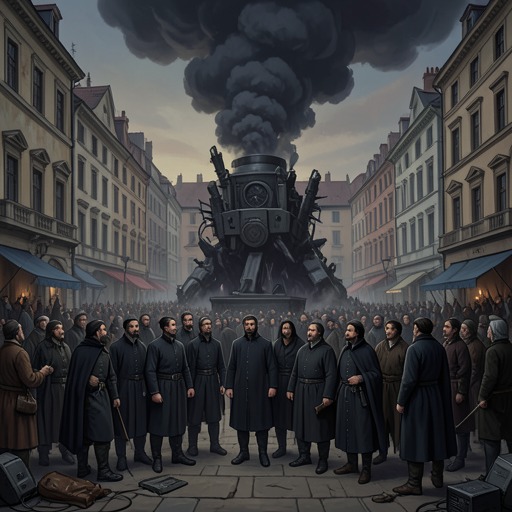
Jetztzeit
The Parallax ViewJetztzeit names a present charged with the possibility of historical decision: a dangerous moment from which a different future might emerge and redeem the past. In the book, the concept belongs to a broader account of history as more than the smooth passage of time. Its force lies in the tension between apparent historical exhaustion and the possibility that a crisis may open a path to reversal.
Historical Time and the Moment of Decision
The book situates Jetztzeit within what it calls the Hölderlin paradigm: a historical present may look like the lowest point in a long decline, yet the danger of irreversible loss can also disclose the possibility of a turn. The possible reversals include proletarian revolution and the arrival of new gods. In this model, the present matters not simply because it is new, but because a decision made under conditions of danger could alter the relation between past and future.
This account contrasts with an imagined, nonhistorical universe in which time simply flows without a teleological curve. In such a universe, there would be no decisive juncture from which a brighter future could redeem what came before. Jetztzeit therefore marks a particular conception of historical time: the present can become a threshold, rather than merely another point in an unbroken sequence.
Closure, Aftermath, and Intervention
The book complicates the expectation that history must culminate in a future event still to come. In its account of radical Christianity, the decisive event has already happened: the Messiah has arrived, and the present is lived in its aftermath. This completed history does not necessarily require passive contemplation. The same paradox appears in Hegel’s image of the Owl of Minerva taking flight at dusk: understanding comes after a historical formation has reached maturity, yet recognition of that closure can open space for active intervention.
This complication also resists treating any present as automatically exceptional. Despite Søren Kierkegaard’s attacks on the mass society of the present age, the book notes that he does not simply rely on a historical vision in which his own age is uniquely decisive. Jetztzeit is thus not a license to declare every moment a turning point. Its significance depends on a real historical tension and on the possibility that the apparent end of a process may reveal a choice or reversal within it.
The Revolution’s Uneven Chronology
The book’s discussion of the October Revolution gives this question a concrete historical setting. Sheila Fitzpatrick’s account places collectivization and rapid industrialization within the revolution’s own dynamic, and dates the end of the revolutionary sequence not to its initial years but to 1937, when the purges were cut short and the Party nomenklatura stabilized as a new class. On this reading, the revolutionary process cannot be reduced to a brief founding moment followed by an unrelated Stalinist deviation.
The intervening periods had sharply different effects. From 1917 to 1921, society remained in a state of emergency; the New Economic Policy consolidated Soviet state power while leaving much of social life substantially intact. The thrust beginning in 1928 instead aimed directly and brutally to remake that social body: peasants were liquidated as a class of individual owners, and the old intelligentsia of teachers, doctors, scientists, engineers, and technicians was replaced by a new one. The scale of this change is captured by Fitzpatrick’s comparison of Moscow: someone returning in 1924 after leaving in 1914 could still recognize the city and much of its social texture, whereas a return in 1934 would reveal a city transformed beyond recognition.
That chronology makes the revolutionary past neither simply finished nor preserved unchanged. The years of transformation carried a ruthless but sincere and enthusiastic drive to create a new state, intelligentsia, and legal system. The book’s account therefore distinguishes a retreat or consolidation from a later moment that directly altered the composition of society, while locating both within the same contested revolutionary sequence.
Reversal and the Fate of Revolutionary Energy
Isaac Deutscher’s interpretation, as presented in the book, links the inward violence of forced collectivization and industrialization to the revolution’s failure to expand beyond the Soviet Union. A dynamic that could not spread outward turned inward to reshape Soviet society; the liquidation of the kulaks became a substitute for overturning bourgeois rule abroad. The book compares this displacement with Marx’s account of the Napoleonic Wars as an outward release of revolutionary activity after Thermidor had quenched revolutionary agitation. In the Soviet case, the movement was turned around: the failed attempt to extend revolution by military means, ending with the Red Army’s defeat in Poland, preceded the inward thrust of social transformation.
This history does not make Jetztzeit a synonym for revolution, nor does it establish that every upheaval fulfills a redemptive promise. Rather, it clarifies why the present can carry more than one historical meaning. A revolutionary project may survive as unresolved pressure within the order that succeeds it, while its energies are redirected into new forms and conflicts. The decisive moment is therefore bound to both possibility and danger: what appears as the continuation of a revolution may also become the means by which its social world is remade, and its original emancipatory horizon is transformed.